
Artificial intelligence is no longer just for large companies with huge budgets. In 2026, small businesses are using AI tools every day to manage tasks faster, improve customer experience, and grow their brands online. In fact, recent industry reports show that more than 70% of small businesses now use at least one AI-powered tool in their daily operations.
One of the biggest reasons behind this growth is efficiency. AI helps business owners save time, reduce manual work, and cut operational costs without hiring large teams. Tasks that once took hours can now be completed in minutes with the help of smart automation tools.
Today, small businesses are using AI for many purposes, including:
- Content writing and blogging
- Customer support chatbots
- Marketing automation
- Graphic and logo design
- SEO optimization
- Video editing and social media content
Whether you run an online store, local service business, agency, or startup, AI can help simplify your workflow and improve productivity. In this article, you’ll discover the best AI tools for small businesses in 2026, along with their features, benefits, and how they can help your business grow faster.
Table of Contents
How We Selected the Best AI Tools for Small Businesses
Choosing the right AI tools for small businesses is not just about picking the most popular options. We focused on tools that are practical, affordable, and easy to use in real business situations. Since many small business owners are beginners or non-technical users, we prioritized platforms that offer simple setup, helpful support, and time-saving automation. We also considered how well each tool can grow with a business over time without becoming too expensive or difficult to manage.
Selection Criteria
- Ease of use – Simple dashboards and beginner-friendly features
- Affordable pricing – Budget-friendly plans for small businesses
- Automation features – Tools that save time and reduce manual work
- Customer support – Reliable help through chat, email, or tutorials
- Integrations – Compatibility with popular business apps and software
- Scalability for growing businesses – Flexible features that support future growth
Best AI Tools for Small Businesses in 2026
AI tools are no longer just for large companies with huge budgets. In 2026, small businesses are using AI to save time, improve marketing, automate daily work, and grow faster without hiring large teams. From content creation to design and workflow automation, the right tools can make running a business much easier.
Before choosing a tool, it helps to compare the basics like pricing, free plans, and primary use cases.
| Tool | Best For | Free Plan | Starting Price |
|---|---|---|---|
| ChatGPT | Content & productivity | Yes | $$ |
| Canva AI | Design | Yes | $$ |
| Jasper | Marketing copy | No | $$$ |
| Zapier | Automation | Yes | $$ |
| Semrush AI | SEO | Limited | $$$ |
OpenAI — Best for Content Creation & Productivity
OpenAI offers one of the most powerful AI tools for small businesses through ChatGPT. It helps users create blog posts, emails, social media captions, product descriptions, customer support replies, and more within minutes. Small teams can also use it for brainstorming ideas, summarizing documents, and improving productivity.
One of the biggest advantages is its flexibility. Whether you run an ecommerce store, agency, startup, or local business, ChatGPT can fit into daily operations easily. Pricing includes a free version, while advanced plans unlock better models, team collaboration, and additional features.
Pros:
- Easy content generation
- Saves time
- Multi-purpose tool
Cons:
- Needs fact-checking
- Advanced features may require paid plan
Canva AI — Best for Social Media & Graphic Design
Canva has become a favorite among small businesses because it makes design simple even for beginners. Its AI tools can generate images, create presentations, remove backgrounds, and produce social media graphics quickly.
The platform also includes ready-made templates for Instagram, Facebook, YouTube, and marketing materials. Brand kit tools help businesses maintain consistent colors, logos, and fonts across all designs. Canva’s free plan is useful for startups, while premium plans unlock more templates and AI features.
Pros:
- Beginner-friendly interface
- Huge template library
- Fast social media content creation
Cons:
- Some AI features are limited in the free version
- Advanced customization can feel restricted
Zapier — Best for Business Automation
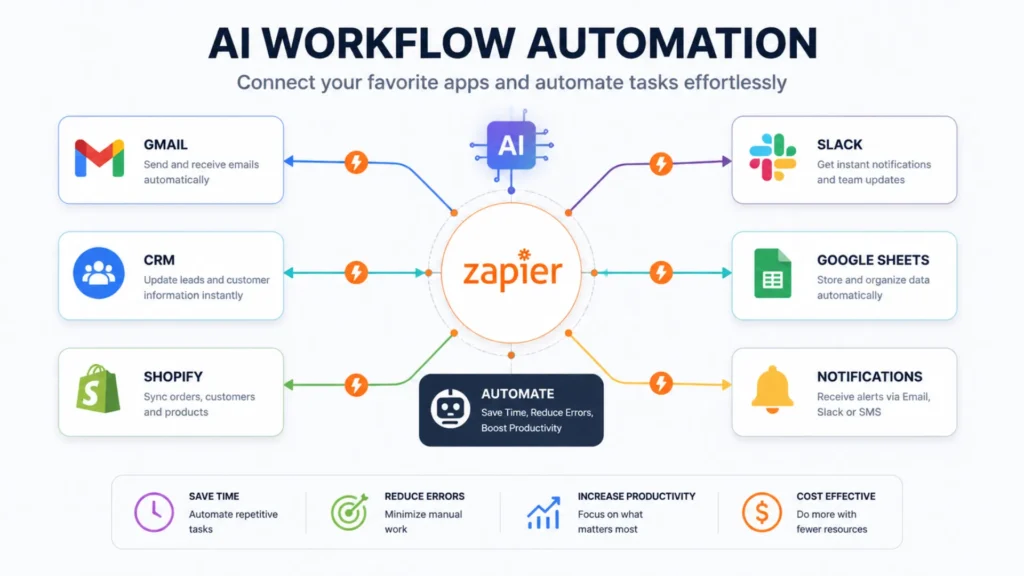
Zapier helps small businesses automate repetitive tasks without coding. It connects thousands of apps including Gmail, Shopify, Slack, Google Sheets, and Trello to create automated workflows called “Zaps.”
For example, businesses can automatically save email attachments, send customer notifications, update spreadsheets, or create tasks when new orders arrive. This saves hours of manual work every week and reduces human error. Zapier offers a free plan for basic automations, while paid plans support advanced workflows and higher task limits.
Best For:
- Ecommerce stores
- Agencies
- Service businesses
Semrush AI Tools — Best for SEO & Marketing
Semrush provides AI-powered tools designed for SEO and online marketing. Small businesses can use it for keyword research, competitor analysis, content optimization, and tracking search rankings.
Its AI writing and optimization features help create content that is more likely to rank on search engines. Businesses can also analyze competitors to discover traffic sources, backlink opportunities, and content gaps. While Semrush can feel expensive for beginners, it offers strong value for companies focused on long-term online growth.
Pros:
- Powerful SEO insights
- Excellent competitor research
- Helpful content optimization tools
Cons:
- Higher pricing than some alternatives
- Learning curve for new users
Descript — Best for Video & Podcast Editing
Descript is an AI-powered editing platform made for creators, marketers, and business owners producing video or podcast content. It simplifies editing by allowing users to edit audio and video like a text document.
The platform includes AI voice editing, automatic captions, screen recording, and podcast production tools. This makes it especially useful for businesses creating YouTube videos, webinars, training content, or podcasts for marketing.
Descript is ideal for content creators, coaches, agencies, and brands that regularly publish audio or video content. It offers a limited free plan, while paid plans provide longer editing hours and advanced AI features.
Free vs Paid AI Tools — Which One Should You Choose?
Choosing between free and paid AI tools depends on your business needs and budget. Free AI tools are great for beginners, startups, and small teams that only need basic content creation, automation, or customer support features. They help businesses test AI without spending money upfront.
However, as your business grows, paid AI tools become more valuable. They usually offer advanced automation, better accuracy, faster performance, integrations, analytics, and priority customer support. Paid plans also handle larger workloads more efficiently, making them ideal for scaling operations.
| Feature | Free AI Tools | Paid AI Tools |
|---|---|---|
| Features | Basic | Advanced |
| Support | Limited | Priority |
| Automation | Basic | Advanced |
| Scalability | Low | High |
If your daily tasks are simple, free tools may be enough. But businesses looking for growth, efficiency, and long-term productivity should consider upgrading to paid AI solutions.
How to Choose the Right AI Tool for Your Business
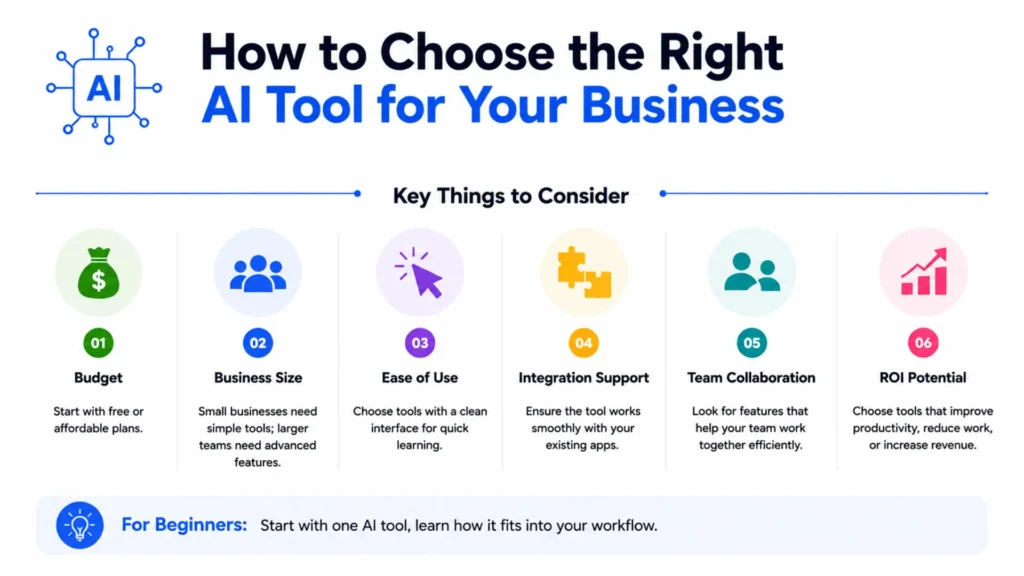
Choosing the right AI tool depends on your business goals, budget, and how your team plans to use it. Instead of picking the most popular platform, focus on tools that solve real problems and save time in daily work. A good AI tool should be easy to use, flexible, and capable of growing with your business over time.
Key Things to Consider
- Budget – Start with tools that offer free plans or affordable pricing before investing in premium features.
- Business size – Small businesses may need simple tools, while larger teams often require advanced automation and management features.
- Ease of use – Choose platforms with a clean interface so your team can learn quickly without technical training.
- Integration support – Make sure the tool works smoothly with apps you already use like CRM, email, or project management software.
- Team collaboration – Look for features that allow multiple team members to work together efficiently.
- ROI potential – Focus on tools that can improve productivity, reduce manual work, or increase revenue.
For beginners, it’s smart to start with one AI tool, learn how it fits into your workflow, and then expand gradually as your business needs grow.
Final Verdict — Which AI Tool Is Best in 2026?
Choosing the best AI tool in 2026 depends on your business needs, but a few platforms clearly stand out. For overall performance and versatility, ChatGPT remains one of the best choices for content, research, customer support, and productivity. If you need a budget-friendly option, Canva AI offers excellent value for small businesses. For marketing, Jasper AI is a strong pick, while Zapier continues to lead in automation and workflow management.
Businesses that adopt AI early in 2026 will gain a major competitive advantage. Start with one AI tool and scale gradually as your business grows.